
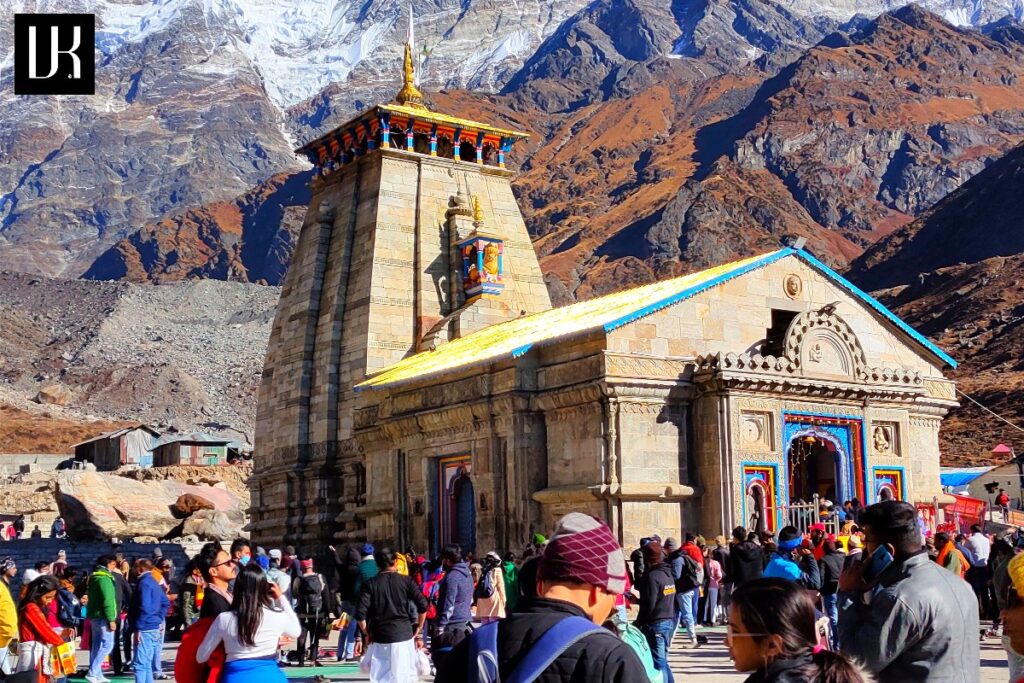
According to Hindu mythology, Lord Shiva appeared as Jyotirlings at 12 locations for the well-being of our planet; the shivlings present at these 12 locations are known as “Jyotirlingas.” Situated in the Rudraprayag district of Uttarakhand, the Kedarnath Dham is one of these twelve Jyotirlingas. Many pilgrims visit Kedarnath Dham each year because of their unwavering devotion to Mahadev or Lord Shiva.
The Kedarnath temple is encircled by mountains on all three sides, at one side there are 22000 ft high Kedarnath mountain, on the second side it has 21600 ft. high Karch Kund and on the third side, it has 22000 ft. high Bharat Kund. Along with the three mountains, it is also considered to be the confluence of five rivers: the Mandakini, Madhu Ganga, Kheerganga, Saraswati, and Swarngauri. Only the Mandakini river is visible.
History behind the sacred Kedarnath temple
The history of how the Kedarnath temple was built has been the subject of numerous discussions. This temple, which is thought to be 1,000 years old, was allegedly built by the descendant of the Pandavas – Janmjay.
The Kedarnath temple was built in the tenth century by the King bhoj of Malwa, according to a Stuti of the raja bhoj of Gwalior. Another popular belief holds that Guru Adi Shankaracharya erected the temple’s foundation stone in the eighth century. On the backside of the temple, there is also a recently built memorial of Shankaracharya.
Two tales are very popular pertaining to the Kedarnath temple. According to the first one, two incarnations of Lord Vishnu, great ascetics Nar and Narayan, used to meditate on the peak of the Kedar Parvat. Lord Shiva became pleased with their devotion and appeared before them, promising to reside there in the form of a Jyotirlinga. This tale is one of the two most well-known ones relating to the Kedarnath Temple.
In the second narrative, after winning the war with the Kauravas, there was a sin on the Pandavas for killing their family members. To get rid of this sin and to obtain Lord Shiva’s blessings, who was furious with the Pandavas for killing their siblings, Pandavas arrived at the Kedar looking for Lord Shiva.
To avoid meeting the Pandavas, Shiva took the form of a bull and got mingled in a vast herd of bulls. Bheem placed his legs on both mountains to locate Lord Shiva because the Pandavas believed that he must be among the bulls. Other bulls crossed beneath Bheem’s legs, but Shiva did not. Bheem grabbed the bull. When Lord Shiva noticed the Pandavas’ strong devotion and resolve, he stood before them and absolved them of their sins. Since then, Lord Shiva is worshipped as the hump of a bull in the Kedarnath temple.
Significance of the Kedarnath Temple
The temple is 187 feet broad and 85 feet tall. Outside the temple, in the entryway is a large statue of “Nandi” that welcomes you. Inside the Kedarnath temple, a conical rock formation known as the “Sadashiva” form of Shiva is worshipped. Inside the temple are a “Garba Griha” for worship and a “Mandap” for visitors.
Kedarnath Dham, located in the foothills of the Himalayas is the largest temple dedicated to Lord Shiva in Uttarakhand. It is believed that worshipping the deity who rules the temple will grant all of your wants as well as free you from sin and evil powers. People’s devotion to the temple is evident in the increasing number of pilgrims that come here every year.
The overwhelming cosmic light positivism that the holy site delivers is what draws devotees to the auspicious Kedarnath temple, to enlighten their spirits. Pilgrims fervently think that a trip to the Kedarnath Dham will give them the path to achieve Moksha, or freedom from all of their wrong-doings, in addition to the calm, tranquilly, wisdom, and mesmerizing scenic beauty of the Himalayas.